

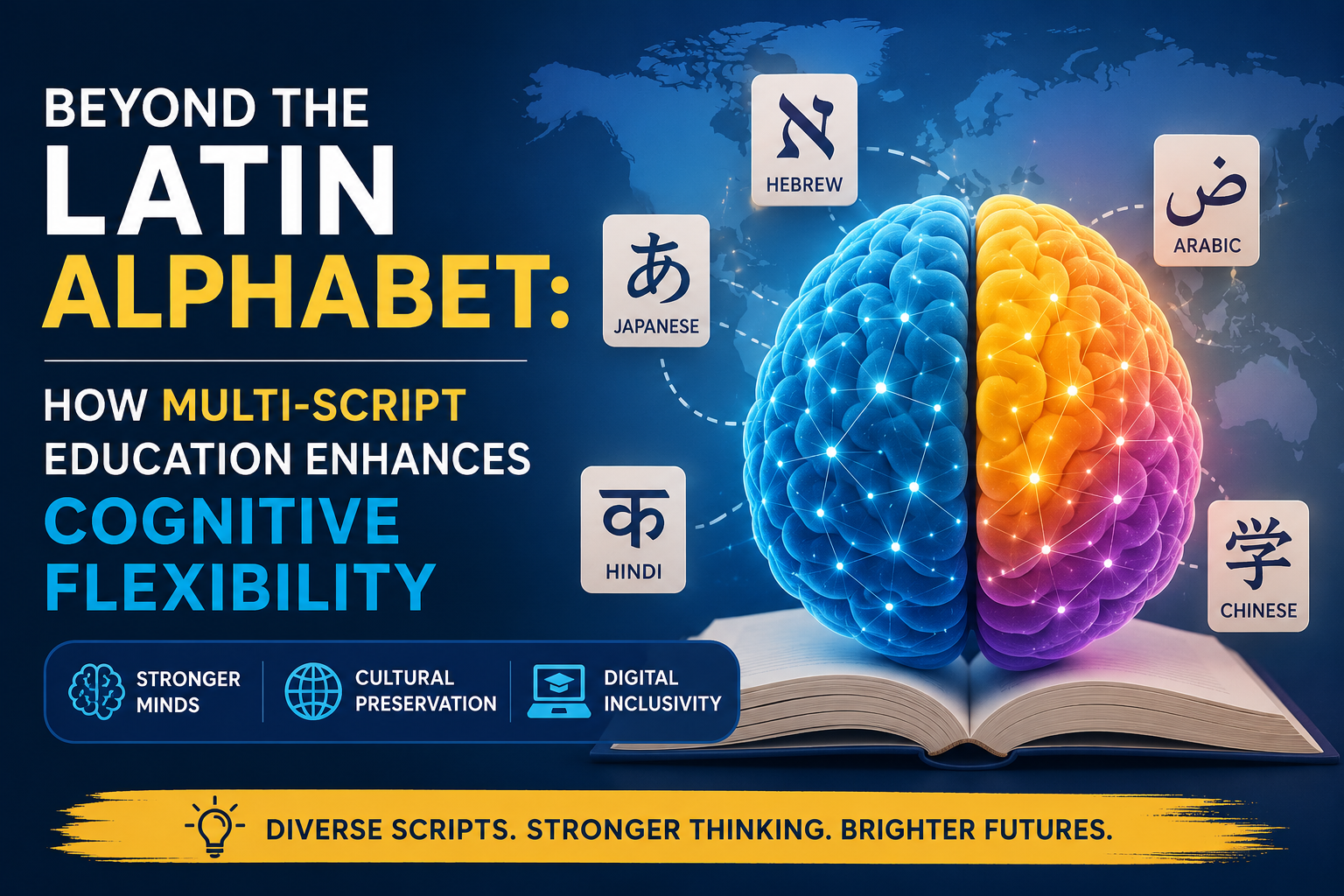
Beyond the Latin Alphabet: How Multi-Script Education Enhances Cognitive Flexibility
As education becomes increasingly global, preparing learners for an interconnected world requires more than teaching a single language or writing system. While English and other Latin-script languages dominate many classrooms, there is growing recognition that exposure to diverse writing systems can enrich learning experiences and foster valuable cognitive skills.
From Hebrew and Arabic to Japanese and Korean, non-Latin scripts challenge learners to think differently. They introduce new visual patterns, reading directions, and linguistic structures that encourage adaptability, curiosity, and deeper engagement with language itself.
Why Script Diversity Matters
For many students, reading and writing begin with the Latin alphabet. Although this provides a strong foundation, relying exclusively on one writing system may limit exposure to the remarkable diversity of human communication.
Every script represents a unique way of organizing language. Hebrew, for example, is written from right to left and is based primarily on consonants, while Japanese combines multiple writing systems that work together to express meaning and pronunciation. Learning these systems encourages students to approach language from fresh perspectives.
Rather than viewing unfamiliar scripts as obstacles, educators increasingly recognize them as opportunities to expand learners' cognitive and cultural horizons.
The Cognitive Benefits of Learning Multiple Scripts
Research in multilingual education suggests that learning additional languages can support cognitive flexibility, attention control, and problem-solving. Encountering entirely different writing systems adds another dimension by requiring learners to process unfamiliar visual information and adapt to new reading conventions.
Learning non-Latin scripts can help students strengthen skills such as:
Pattern recognition through identifying new character shapes and structures.
Visual attention by distinguishing similar symbols.
Working memory while connecting sounds, meanings, and written forms.
Mental flexibility by switching between different writing systems.
Analytical thinking through understanding alternative linguistic structures.
These abilities extend beyond language learning and can benefit academic performance across many disciplines.
Language Learning as Cultural Preservation
Languages preserve history, identity, and collective knowledge. Every writing system carries centuries of literature, philosophy, religion, and cultural traditions that would be difficult to fully appreciate through translation alone.
Introducing learners to diverse scripts helps preserve linguistic heritage while promoting respect for cultural diversity. Students gain a broader understanding of civilizations and develop greater appreciation for the many ways societies communicate, record knowledge, and express ideas.
Educational organizations committed to inclusion can play an important role by encouraging learners to explore languages beyond those most commonly taught in mainstream curricula.
Digital Education Is Removing Traditional Barriers
Not long ago, studying less commonly taught languages often required access to universities, specialized teachers, or expensive textbooks. Today, digital learning has transformed accessibility.
Interactive platforms provide guided lessons, pronunciation support, handwriting practice, quizzes, and visual exercises that make unfamiliar scripts approachable for learners of all ages. Students can now study historical and modern languages from virtually anywhere in the world at their own pace.
This democratization of education helps ensure that learners are no longer limited by geography or institutional availability.
Technology Is Making Diverse Scripts More Accessible
Modern educational technology has made learning unique writing systems significantly more approachable. Interactive lessons, visual exercises, and structured learning paths allow students to explore languages that once seemed intimidating.
Educational platforms such as Hebrew Mastery help learners understand the Hebrew alphabet, pronunciation, vocabulary, and grammar through engaging digital lessons that make one of the world's oldest continuously used writing systems accessible to beginners.
Similarly, Japanese-Symbols.org introduces learners to the meaning, history, and cultural significance of Japanese symbols and characters, helping students better understand one of the world's most distinctive writing traditions.
Together, these educational resources demonstrate how digital learning can encourage curiosity, improve accessibility, and support lifelong learning across diverse linguistic traditions.
Building Inclusive Global Citizens
The future of education is not simply about teaching more languages—it's about exposing learners to different ways of thinking.
Students who engage with multiple writing systems develop resilience, adaptability, and greater confidence when encountering unfamiliar information. They become better equipped to collaborate across cultures and appreciate the diversity that shapes our global society.
For educators, NGOs, and digital learning providers, promoting script diversity is an investment in more inclusive education. Every new alphabet or writing system represents another opportunity to broaden perspectives, strengthen learning skills, and preserve cultural heritage for future generations.
Conclusion
Learning beyond the Latin alphabet is about far more than memorizing new characters. It encourages learners to think differently, recognize patterns in new ways, and engage more deeply with cultures outside their own.
As digital education continues to expand access to specialized language resources, students around the world can explore writing systems that were once difficult to study. By embracing multi-script education, we not only preserve linguistic diversity but also cultivate the cognitive flexibility and global awareness that are increasingly valuable in the twenty-first century.

